Why Switching Domain Registrars Could Save You Thousands
Fed up with hidden fees and long response times from your domain registrar?
28 Oct 2025
Read now



Websites that copy or target your brand rarely appear out of nowhere. In many cases, the “website problem” starts earlier at the domain layer: someone registers a domain name that imitates your brand, then later uses it to host a fake website, run phishing campaigns, sell counterfeit goods, or impersonate your organisation via email.
That is why the most reliable way to find websites targeting your brand is not to search the web for lookalike sites. It is to start with a structured domain based approach that detects suspicious registrations early, evaluates whether those domains are being registered for abuse and escalates the right cases into takedown or dispute resolution.
A mature process looks like this:
Domain Audit → Domain Watch → Investigation → Enforcement (where needed).
This article explains why websites targeting brands exist, the risks they create and a practical step by step guide to find them (and take them down where necessary) before they cause harm.
A website targets your brand when it uses your name, identity, products, or trust signals in a way that misleads users or diverts value. This does not always mean the site uses your logo or copies your design. Many modern threats are subtle and designed to look just believable enough, to trick customers, suppliers, or employees.
In practice, most websites targeting brands fall into one of these categories:
These sites impersonate login pages, password reset portals, customer support tools, HR systems, or payment flows. The goal is typically to steal credentials, payment details, or personal information.
Some threats do not require a website at all. Attackers may register a lookalike domain and configure it for email (for example, enabling MX records), then impersonate executives, procurement teams, suppliers, or finance departments.
These sites replicate product pages and branding to sell counterfeit goods or take payment without delivering products. Even when customers realise the fraud, they often associate the negative experience with the real brand.
Some domains are registered purely to create confusion, dilute the brand, divert traffic, or extract value (for example, selling the domain back to the brand owner). These domains may be inactive at first but can later become harmful.
The key point is that brand targeting is not only a marketing issue. It is also a legal, operational, and cybersecurity risk. They can expose customers to harm, increase incident response workload and create reputational damage that persists long after a fraudulent site is removed.

Brand imitation works because trust is expensive to build and easy to borrow.
Attackers register domains that look like real brand domains because the domain itself creates credibility. A user who sees a familiar name in a URL is more likely to click, more likely to enter details, and more likely to believe a message is legitimate. Even sophisticated users can be misled if the domain is close enough to the real one, especially when the deception is delivered under time pressure (for example, “verify now”, “payment overdue”, or “account locked”) or when the attackers uses Internationalised Domain Names (IDNs) almost indistinguishable to the human eye (for example using a Cyrillic а instead of the Latin a).
There is also a scale factor. Copycat operations are often systematic. Bad actors will register hundreds of variations across multiple extensions, using predictable naming patterns. This is why copycat domains and websites cannot be addressed effectively with occasional manual searches. Without proactive monitoring, you will always be reacting late.
Many organisations start by searching their brand name online, hoping to discover copycats the way they would discover reputation issues or press coverage. Unfortunately, this approach has limitations.
Search engines do not reliably index phishing pages. Malicious sites may be short lived, hidden behind redirects, restricted by geography and device, or deliberately blocked from indexing. In many cases, the harmful content appears only for specific users or only after a click through from a targeted email campaign.
In addition, some of the most damaging brand abuse happens without a website. If a lookalike domain is configured for email impersonation, it can be used to send fraudulent communications even if the domain never hosts a webpage. This means a “web search” approach misses a significant portion of real world brand targeting.
The best approach to mitigate this risk is domain-led: detect the suspicious domains first, then investigate whether they are being used for websites, email, or other infrastructure.
Copycat operators rarely register a domain that is identical to your brand. Instead, they register domains that are close enough to create confusion and they do so in ways that scale. This is why defining your detection scope is one of the most important parts of the process. If you only look for exact brand matches, you will miss the majority of brand targeting activity, including many of the highest risk domains used for phishing and impersonation.
A robust scope starts with the obvious: domains that include your brand name as a string, either on its own or combined with additional words.
These added words are rarely random. They are usually selected to increase trust or urgency and to make the domain feel like an official brand sub site. Common examples include “login”, “secure”, “verify”, “support”, “account”, “portal”, “billing”, “invoice”, “helpdesk”, and “tracking”. When these terms appear alongside a brand name, they often indicate an intent to imitate customer access pages, internal systems, or support workflows.
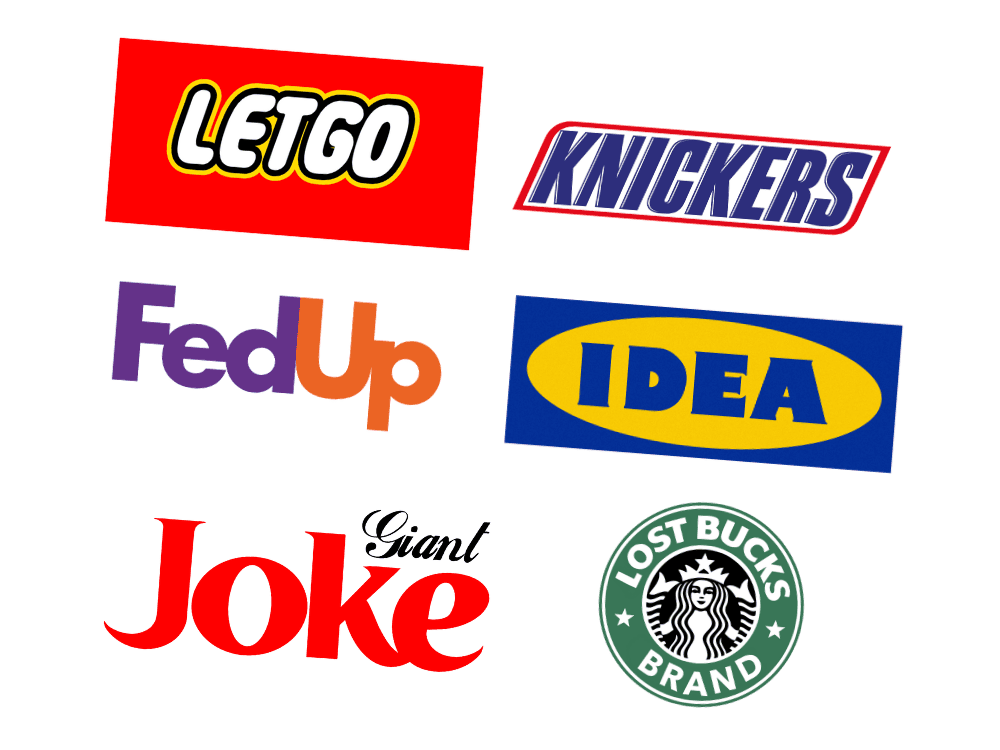
From there, the scope should expand into the systematic “variation families” that attackers use to create convincing lookalikes. One of the most common families is misspellings and typographical variants (often called typosquatting). These include omitted letters, repeated letters, swapped letter order, or keyboard adjacent substitutions. They may also include inserted characters, added hyphens, or subtle formatting changes designed to preserve readability at a glance while defeating simple exact match checks.
Brands that can be interpreted phonetically should also account for similar-sounding and homophone variants. These domains preserve the sound of the brand while changing spelling and they are particularly effective when a user is scanning quickly or when the domain is shared verbally. Even a single letter change can be enough to fool recipients who rely on recognition rather than careful inspection
They can also target domains that make use of non-Latin script, called IDNs. IDNs can contain characters from other scripts that visually resemble Latin characters. In many fonts, certain Cyrillic or Greek characters appear nearly identical to “a”, “e”, “o”, “c”, or “p”. This allows attackers to register domains that look legitimate to the human eye, particularly in emails and messaging apps where users do not scrutinise URLs closely.
Finally, an effective scope includes TLD strategy. Attackers do not choose extensions at random. They register domains in country-code TLDs that match the brand’s markets, in widely trusted extensions and in newer extensions that make the domain read like a category. It is also common for the same lookalike domain to be registered across multiple extensions to increase resilience and to continue the campaign even if one domain is taken down.
In addition to the corporate brand name, many organisations also include brand-adjacent assets in scope. This can include product names, app names, campaign names, service lines and key terms used in customer journeys. It can also include executive names and department terms where invoice fraud or supplier impersonation is a concern. Copycats target the path of least resistance, and sometimes the easiest deception uses a product name that is less monitored than the parent brand.
The outcome of Step 1 should be a defined scope that is realistic, enforceable, and aligned to risk. You are not trying to capture every domain that is vaguely similar. You are defining the patterns that are most likely to be used to cause confusion or harm
A Domain Audit establishes a baseline view of domains registered around your brand. It identifies registrations that incorporate your brand, imitate it, or are confusingly similar. This baseline matters because it shows what already exists and helps you separate owned domains to known issues and newly emerging threats.
A well structured audit does not simply produce a list of domains. It produces an actionable dataset. That means domains should be grouped into meaningful categories (for example, owned/legitimate, unclear, likely abusive), and the dataset should include enough context to support investigation and enforcement decisions later.
This is also where many brands discover that their threat surface is broader than expected. Brands are often copied not only through the corporate name, but also through product names, campaign names and regional identifiers.
A Domain Audit tells you what exists now. A Domain Watch tells you what appears next.
A Domain Watch is continuous monitoring for newly registered domains that contain or resemble your brand, including variations designed to confuse users. The value of Domain Watch is speed. The earlier you detect a suspicious domain, the more options you have to act before harm occurs.
This is especially important because many harmful domains are registered long before they are used. They may sit dormant while the operator prepares the phishing infrastructure, obtains SSL certificates, or builds a copycat storefront. Domain Watch allows you to see those registrations as they happen, rather than discovering them only after a customer has been defrauded.
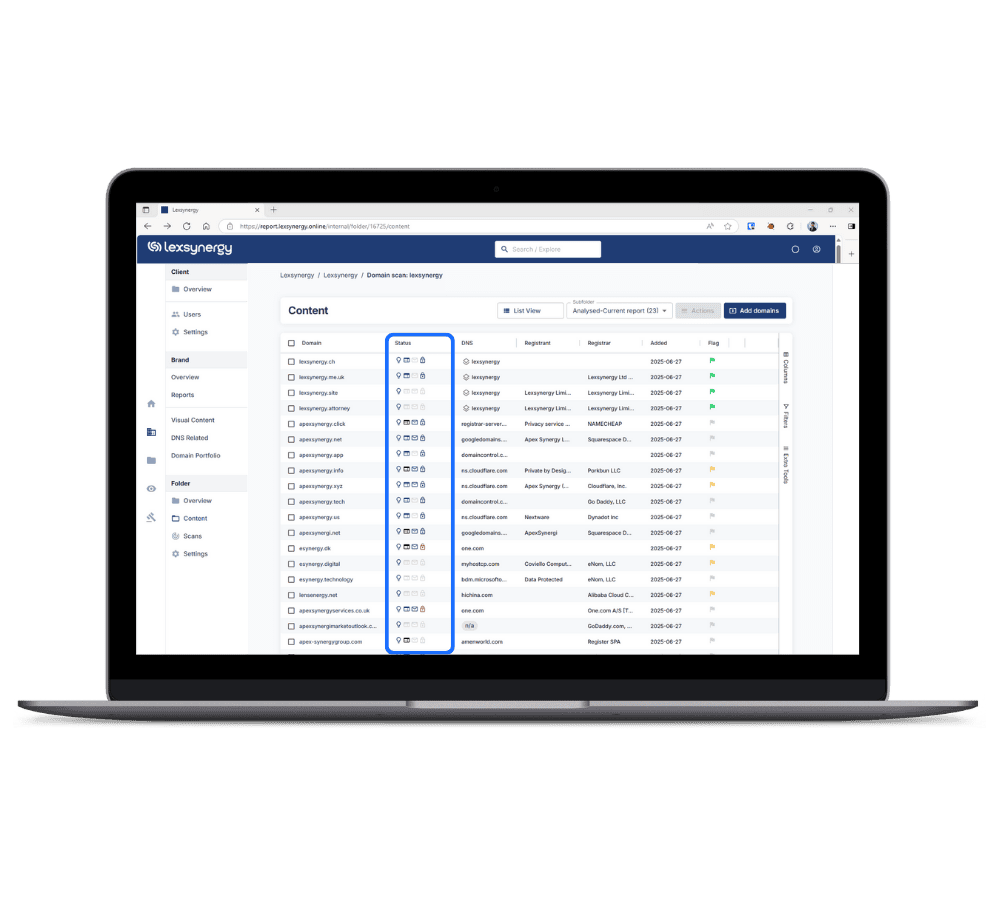
Not every suspicious domain becomes a harmful website. Many are inactive, parked, or speculative. The most effective way to prioritise is to look for activation signals that indicate the domain is being prepared for abuse.
One of the strongest signals is email functionality. If a lookalike domain has MX records configured, it can be used for email impersonation. This is a high risk indicator even if no website is visible.
Another signal is SSL certificate issuance. When a domain suddenly has a certificate, it is often being prepared for a live website. Many phishing campaigns rely on HTTPS because it makes the site appear legitimate.
Finally, is there direct website activity? If the domain resolves to a live site, that content can be reviewed for brand misuse, deception, or fraud. It is common for domains to switch rapidly between parked pages and active malicious content, so timing matters.
Copycat websites are not stable. They often disappear, change content, or move infrastructure quickly in response to enforcement pressure. That is why evidence capture must be part of the process.
The evidence you collect should support both legal and technical escalation. That typically includes time stamped screenshots of website content, DNS records and configuration details, SSL certificate data and email configuration indicators.
This evidence is what enables decisive action. Without it, enforcement becomes slower and less reliable, because the operator can claim the domain is inactive or the harmful content can be removed temporarily during review.
Once you have a pipeline of suspicious domains and sites, you need a risk framework. Otherwise, teams become overwhelmed by volume and spend time on low impact cases.

The most urgent cases are those involving phishing indicators, email impersonation readiness, active counterfeit commerce, or clear deceptive content. These are the cases where delay creates direct harm.
Medium risk cases include confusing similarity combined with partial activation signals, such as SSL issuance or recent DNS changes. These domains may be in preparation stages.
Lower risk cases include inactive domains with no activation signals, or domains that are similar but unlikely to cause confusion.
This triage step is where many organisations benefit from specialist support, because it requires both legal judgement and technical interpretation. In practice, it is not enough to identify “similar” domains, you need to determine which cases are likely to cause harm, which are enforceable and which actions will achieve the fastest and most durable outcome.
This is where Lexsynergy supports brand owners through a managed Domain Watch service, providing structured review and analysis of watch results, highlighting potential infringements and helping teams focus on the cases that matter most. For organisations managing international brands or large-scale domain portfolios, this approach helps convert raw monitoring data into prioritised, actionable casework that can be escalated efficiently into enforcement when needed.
When a copycat site is confirmed, the response route depends on the type of abuse, the jurisdiction and the infrastructure involved.
Some cases can be resolved through take down actions with hosting providers or platforms. Others require domain level escalation through registrars or registries. In some situations, formal domain dispute resolution procedures may be appropriate, particularly where the domain itself is a valuable asset to recover.
It is important to understand that enforcement is rarely a single action. It is a managed workflow that includes investigation, evidence capture, escalation, follow-up and monitoring for recurrence.
Brand targeting is not a one time event. Once a brand becomes a known target, operators often return with new variations, new extensions and new infrastructure. In many cases, the same individuals or groups will recycle proven naming patterns, simply changing a character, switching to a new TLD, or moving hosting providers after a take down.
That is why an ongoing Domain Watch is essential. It prevents the organisation from being caught repeatedly by small variations of the same abuse pattern and it ensures that new threats are identified at the earliest possible stage, often before a domain is fully operationalised.
Many mature programmes also implement deeper monitoring for known domains, tracking changes in DNS configuration, email readiness, registrar transfers, SSL certificate issuance and website content over time. This is particularly valuable because some domains remain dormant for long periods and then become active with little warning. Monitoring helps teams detect that transition quickly, capture evidence and act before harm escalates.
Importantly, proactive monitoring combined with consistent enforcement does more than remove individual threats, it can change the risk calculus for attackers. Brands that are known to detect lookalike domains early, respond quickly and enforce rights consistently often become less attractive targets over time. While no brand can eliminate abuse entirely, sustained monitoring and repeatable enforcement creates friction, increases attacker costs and acts as a deterrent against opportunistic copycat activity.
If you want to find websites that copy or target your brand, the most reliable strategy is to start with a domain led process:
If you manage an international brand or large domain portfolio, brand targeting becomes a volume problem as well as a legal and security problem.
Implementing an effective Online Brand Protection Strategy incorporating a Domain Audit and ongoing Domain Watch is often the most effective way to detect threats early and respond consistently.
Get in contact to discuss how to implement this strategy at scale, including monitoring scope, evidence capture and enforcement options.
A website may be impersonating your brand if it uses your name, branding, or customer facing language to mislead users into believing it is official. Common signs include lookalike domains, copied design elements, fake login pages, suspicious payment flows, and urgent prompts such as “verify your account” or “reset password.”
Impersonation is often paired with deceptive email campaigns, so it is important to investigate the domain’s email configuration as well.
A lookalike domain is the domain name itself, designed to resemble your official domain. A copycat website is content hosted on that domain that imitates your brand. Many lookalike domains never host content, but can still be used for email impersonation. In other cases, a lookalike domain becomes a live copycat website later.
Typosquatting is the act of registering or using a domain name that contains typographical errors or spelling mistakes of a trade mark. Examples include missing letters, swapped letters, added hyphens, or substituted characters. Typosquatted domains are often used for phishing, fraud, or traffic diversion.
Cybersquatting is the registering and/or use of a domain name that is identical or confusingly similar to a trade mark, company name or personal name with the intent to profit from the goodwill of that trade mark.
Start by identifying domains that contain your brand name or resemble it, then investigate whether they host live content. Domain led detection is often faster than web searching because many copycat sites are not indexed. If the site is live, capture time stamped screenshots and document the content for escalation.
Because many high impact attacks use domains primarily for email impersonation. A lookalike domain with MX records enabled can be used to send fraudulent emails that appear legitimate. This can lead to invoice fraud, supplier impersonation and credential theft even if no website exists.
An SSL certificate often indicates that the domain is being prepared for a live website. Phishing operations frequently use HTTPS to appear legitimate. SSL alone is not proof of abuse, but it is a strong activation signal and should increase the domain’s priority for investigation.
Fed up with hidden fees and long response times from your domain registrar?
That tiny missing “m” has the potential to lead your customers to a completely unrelated site, a competitor, or a scam, all of which could have been avoided.
Yes. A domain can be used for email impersonation, redirect traffic, host files, or support fraudulent infrastructure without hosting a visible website. That is why monitoring the domain layer (including DNS and email indicators) is essential.
First, capture evidence immediately (screenshots, domain data, DNS/email configuration). Next, assess risk: phishing and fraud cases should be treated as urgent. Then determine the enforcement route: website take down, hosting escalation, registrar/registry escalation, or dispute resolution depending on the situation.
It depends on the infrastructure and jurisdiction. Some takedowns can occur quickly, while domain level actions and dispute procedures may take longer. The speed of resolution is heavily influenced by evidence quality and the escalation pathway used. In urgent phishing cases, takedowns can sometimes be achieved extremely quickly, depending on infrastructure and escalation route.
You cannot prevent all registrations, but you can reduce recurrence through continuous Domain Watch monitoring, early detection and consistent enforcement.
Learn what cybersquatting is, how it can affect your brand and what steps you can take to protect your digital assets from domain infringement.