A step by step explainer and FAQ for brands, businesses and domain decision makers wanting to understand the 2026 round of the Internet Corporation for Assigned Names and Numbers (ICANN) New gTLD Program.
A dotBrand is a significant commitment. It can strengthen trust, improve customer experience and give an organisation greater control over its digital presence. But it is not simply another domain name registration and it is not right for every brand.
For some, a dotBrand could become a powerful part of their digital identity, online security and customer experience strategy. For others, it may be a costly distraction without the internal readiness, use case or long-term commitment needed to make it successful.
The purpose of this article is not to suggest that every brand should apply. Instead, it is to help organisations ask the right questions before the opportunity passes.
A dotBrand is a branded top-level domain, such as .nike, .leclerc or .audi, that is owned and operated by the brand itself. Instead of relying only on traditional domain extensions such as .com, .net or country-code domains, an organisation can create its own controlled digital namespace.

For example, a brand could use domains such as:
Unlike ordinary domain name registrations, applying for a dotBrand means applying to operate an entire top-level domain. It is not simply another defensive or campaign registration, it is a long-term digital infrastructure decision.
The 2026 application window is significant because opportunities to apply for a dotBrand do not come around often.
The last major ICANN application round opened in January 2012 and closed on 30 May 2012. The current round opened on 30 April 2026 and closes 12 August 2026. In practical terms, brand owners who missed the first opportunity have waited almost 14 years for this second major opportunity.
That does not mean every organisation should apply simply because the window is open, but it does mean the decision should be made deliberately. If a dotBrand could support your organisation’s brand protection, security, customer experience or digital transformation strategy, now is the time to assess whether it makes sense.
A dotBrand is most compelling when it solves a clear business problem.
For some organisations, that problem is customer trust. Businesses in highly infringed industries such as banking, consumer goods or pharmaceuticals face constant impersonation, phishing and fraudulent domain activity. A dotBrand creates a clear rule for customers, if it does not end in .brand, it is not an official brand domain.

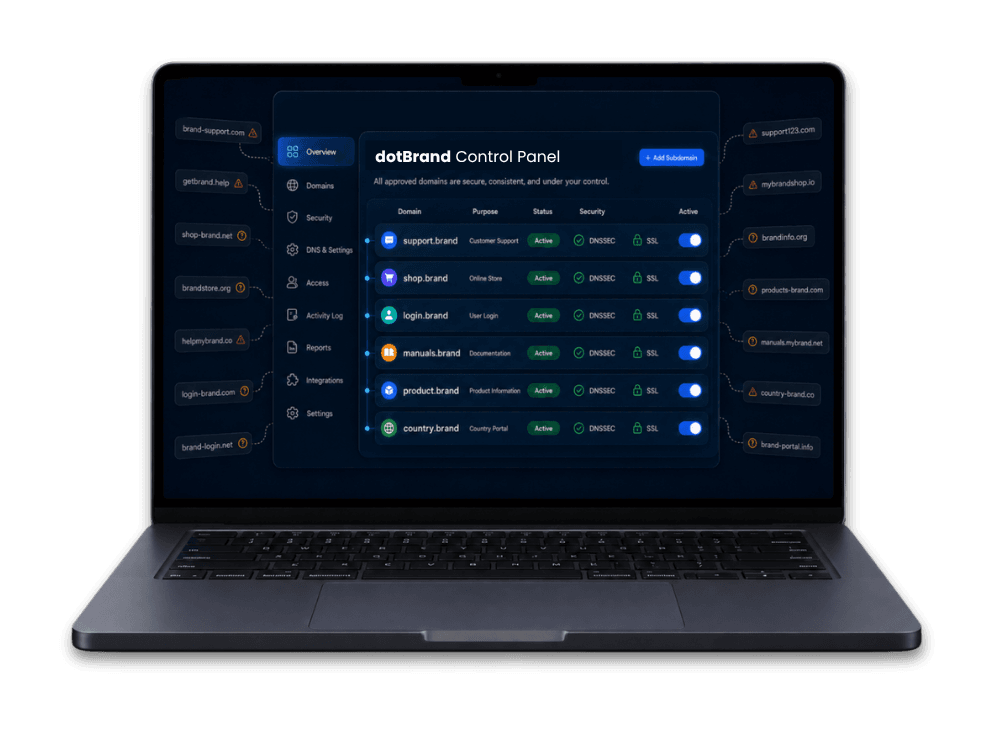
For others, the opportunity is customer experience. A dotBrand can make digital journeys simpler and more intuitive. A customer looking for support, shopping, manuals, or account access can be directed to a short, memorable and trusted domain, think support.brand, shop.brand, manuals.brand, profile.brand.
For larger organisations, the goal may be control. A dotBrand gives the brand owner authority over its own namespace, rather than depending on the availability of names across multiple third-party extensions. It can also create consistency across business units, markets and customer touchpoints, think product.brand, country.brand, login.brand.
The strongest applications are likely to be those where the organisation can clearly explain why the dotBrand is needed and how it will be used.
A dotBrand may be worth serious consideration if your business has a valuable brand, a clear digital strategy and a need for greater control over its online environment.
A dotBrand is particularly relevant where:
A dotBrand is not right for every organisation.
It may not be the right move if there is no defined use case, no internal owner, no budget for long term management or no clear plan beyond simply securing the brand at the top level.
It may also be difficult to justify if the organisation sees it only as a defensive measure. A dotBrand can support online brand protection, but it is not a replacement for a wider domain name, enforcement and online brand protection strategy.
A dotBrand also requires internal alignment.
This is not just a legal project, a marketing project or a technical project. It touches brand, security, governance, customer communications, DNS, compliance and long term digital planning. If those teams are not aligned, the application may be harder to prepare and the dotBrand may be harder to use effectively after delegation.
Before deciding whether to apply, organisations should ask themselves a series of practical questions.
For a dotBrand, the applied for string must be linked to the applicant’s trade mark rights. The applicant will also need to provide supporting information and meet ICANN’s legal, financial and operational requirements.
This means organisations should review their trade mark portfolio, which legal entity should apply, whether the necessary supporting documentation is available and whether the business can demonstrate the ability to operate the registry over the long term.
This is the most important question.
Would the dotBrand be used for customer portals, product information, security pages, investor relations, recruitment, campaigns, internal systems or regional websites?
Would it support one flagship use case or become a broader digital ecosystem?
If the answer is unclear, more strategic work may be needed before applying or a dotBrand simply may not be right for your business.
A useful way to assess readiness is to group the decision into three categories:
Strong case to apply: There is a clear use case, senior level support, trade mark readiness, internal alignment and a long-term plan for using the namespace.
Needs further assessment: There is interest, but the use case, budget, internal ownership or implementation plan still needs work. In this case, a feasibility review may help determine whether an application is realistic before the window closes.
Not right at this stage: There is no clear strategic reason to apply, no internal sponsor or no intention to use the dotBrand beyond defensive ownership. In this case, it may be better to focus on strengthening the existing domain name and online brand protection strategy.

A dotBrand can strengthen digital trust, improve customer experience and give an organisation greater control over its online presence, but it is not right for every brand and it should not be pursued simply because the application window is open.
The better question is whether a dotBrand supports where your organisation is heading.
If it aligns with your security, brand protection, customer experience or digital transformation strategy, it may be worth exploring, if it does not, that is also a valid conclusion.
What matters is making the decision consciously, with the right information and the right stakeholders involved.
Lexsynergy works with organisations to assess dotBrand feasibility, align internal stakeholders and navigate the ICANN application process. If your organisation is considering whether a dotBrand is right for you, now is the time to review the opportunity before the application window closes.
Trust is one of the strongest arguments for a dotBrand.
Could your organisation use .brand as a signal of authenticity? Would customers, employees or partners benefit from knowing that official content appears only within a controlled namespace?
This is particularly important for organisations that are regularly impersonated or operate in high risk sectors.
A dotBrand can create shorter, cleaner and more memorable domains. It can also make navigation more intuitive.
Instead of asking customers to remember long or inconsistent domain names, organisations can create simple destinations such as support.brand, login.brand or careers.brand. However, this only works if the organisation is willing and has the capacity to communicate the change to their customers clearly and consistently.
A successful dotBrand requires cross-functional support.
Legal and IP teams will need to consider trade mark rights, eligibility and application requirements. IT and security teams will need to consider DNS, infrastructure, security and operational planning. Marketing and brand teams will need to consider customer adoption, naming strategy and communications. Senior leadership will need to approve the investment and long-term direction.
If the decision sits with only one department, the dotBrand is unlikely to be adopted effectively.
A dotBrand is not a short-term campaign asset. It is a long-term namespace that will need to be managed, governed and developed.
That means having policies for domain creation, internal approvals, security standards, acceptable use, monitoring and future expansion.
The application is only the beginning. The real value comes from how the dotBrand is used after launch.

Fed up with hidden fees and long response times from your domain registrar?