
Why Switching Domain Registrars Could Save You Thousands
Fed up with hidden fees and long response times from your domain registrar?
28 Oct 2025
Read now


Germany’s national rail operator, Deutsche Bahn, recently experienced a large scale distributed denial-of-service (DDoS) attack that disrupted its online services, including its booking system and widely used DB Navigator app. For passengers, the impact was immediate, with difficulties accessing journey information and completing online transactions over February 17th and 18th, 2026.
While services were restored, the incident is a timely reminder of how quickly availability can be affected when high volume attacks target public facing digital platforms. It also reinforces why resilience must be built into every layer of infrastructure, starting with the systems that make online services discoverable and reachable in the first place, domains.
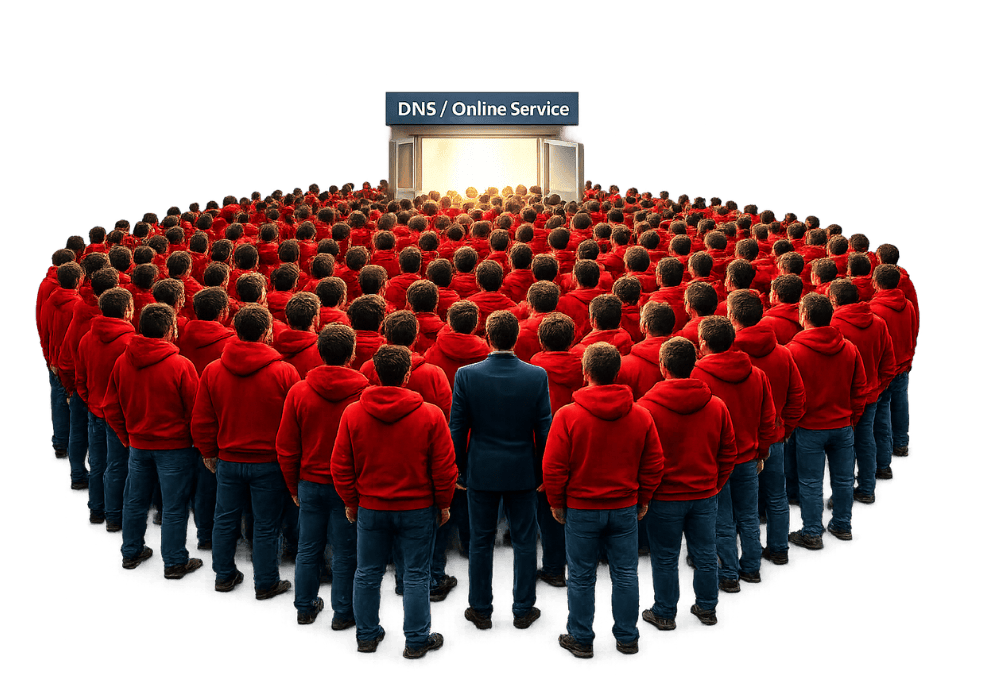
A Distributed Denial of Service (DDoS attack) occurs when a target service is overwhelmed by a flood of internet traffic from many sources, effectively making the service unreachable for legitimate users. It can be compared to trying to exit a packed concert venue through a single doorway while an uncontrolled crowd surges toward it. Even though the exit itself is functional, the sheer volume of bodies pressing forward prevents those at the back from getting through.
DDoS attacks are one of the most common forms of cyber disruption. They are used by criminal groups, hacktivists and other malicious actors to draw attention, extract ransom payments, or destabilise trust in critical infrastructure. When major public services like national transport systems are affected, the consequences can be disruptive. They can erode public confidence and expose operational fragilities as a future target.
For organisations that rely on online platforms to deliver services, the Deutsche Bahn incident serves as a stark reminder that traditional protections may not be sufficient. Attackers do not simply exploit weaknesses in applications. They also target the underlying systems that enable those applications to function, particularly the Domain Name System.
The Domain Name System (DNS) is one of the most critical components of online availability, yet it is often overlooked until something goes wrong. DNS functions as a directory service, allowing users to access websites, send emails and perform other online activities using domain names instead of complex numerical internet protocol addresses.
When DNS is functioning correctly, it is invisible, but when disrupted, even the most robust infrastructure behind a service can become unreachable. Services may remain fully operational, yet users are unable to reach them. DNS disruption can render websites unreachable, block access to applications and interrupt email delivery, despite the underlying systems continuing to run.
This is why DNS resilience must be treated as a foundational requirement for any organisation operating front facing or mission critical services. If DNS becomes a bottleneck or a single point of failure, it creates an unnecessary vulnerability that can be exploited.
At Lexsynergy, we educate businesses that DNS architecture should be considered a core element of risk management and digital governance, not simply a technical configuration.
One of the most effective ways to strengthen DNS resilience is through the adoption of Anycast architecture.
Anycast DNS distributes DNS services across multiple geographically dispersed locations, all operating under the same Internet Protocol address. When a user initiates a DNS query, Internet routing protocols automatically direct that request to the nearest or most responsive available node within the network. If one node becomes unreachable due to an outage, network disruption or attack, traffic is automatically rerouted to another operational node without visible service interruption.
It can be compared to a large venue with multiple exits distributed around the building rather than a single doorway. Instead of everyone being forced through one point, people are directed to the nearest available exit. If one exit becomes blocked, others remain open, allowing the crowd to continue flowing safely and efficiently.
This model improves both availability and performance. Users are typically routed to the closest node, reducing DNS resolution times and contributing to a faster and more consistent user experience.

From a security perspective, Anycast DNS architecture significantly strengthens resilience against volumetric DDoS attacks. By distributing traffic across a global network, malicious traffic is absorbed and diffused rather than concentrated on a single endpoint, making it substantially more difficult for attackers to overwhelm the DNS layer.
Anycast is widely deployed across core Internet infrastructure because of its proven ability to enhance resilience at scale. In our advisory work, we recommend that all public facing and critical services operate on an Anycast enabled DNS infrastructure as a baseline standard.
Lexsynergy provides managed Anycast DNS solutions designed specifically to protect high value domain portfolios, customer facing platforms and business critical services. Our approach combines transparent pricing, high availability architecture as well as continuous monitoring to ensure services remain affordable and reachable under pressure.

The large scale DDoS attack on Deutsche Bahn underscores a fundamental truth about digital infrastructure. Resilience must be designed into every layer, and DNS is one of the most critical.
Anycast DNS is a proven architectural approach that improves availability, strengthens resistance to volumetric attacks and ensures services remain reachable under pressure. For businesses seeking to improve domain and infrastructure resilience, enabling Anycast DNS across all mission critical domains should be regarded as a strategic priority.
If you would like to review your current DNS architecture or explore how Anycast DNS can strengthen the resilience of your critical services, our team would be pleased to advise.
Fed up with hidden fees and long response times from your domain registrar?

Elevate Your Domain Strategy with Cost-Effective, Business-Focused Solutions.
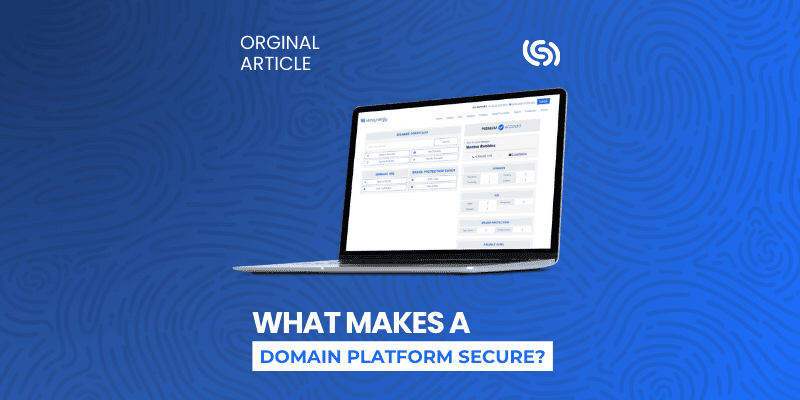
For businesses managing large domain portfolios across multiple regions and TLDs, security is no longer a nice to have, it is essential for control, visibility, accountability and resilience.