
What is the Environmental Cost of a Domain Name?
The environmental impact of owning a domain name is relatively low compared to other digital activities, but it is not zero.
5 Jun 2025
Read nowThe banking industry operates on trust. Every interaction, from a customer checking their balance to a corporate treasury team managing millions, depends on knowing the entity on the other end is legitimate and secure.
This is where the .bank domain extension has transformed the online space for financial institutions. Unlike open domain extensions such as .com or .net, .bank is exclusively restricted to verified members of the global banking community. This includes retail banks, savings associations, credit unions, bank holding companies and official banking regulators. By design, it is a secure and trusted namespace created specifically to strengthen consumer confidence and reduce the risk of phishing and customer fraud.



Introduced in 2015 and managed by our good friends at fTLD Registry Services, the .bank extension requires every applicant to go through a rigorous verification process. Only verified banking entities or their subsidiaries are eligible for registration and every year this verification is repeated to ensure ongoing compliance. This level of scrutiny ensures that when a customer visits a .bank domain or receives an email from an email address ending in .bank, they can be confident they are interacting with a legitimate financial institution.
Registering a .bank domain is unlike registering a typical .com. The process is deliberate and heavily regulated to maintain the integrity of the space.
Banks must first undergo pre verification with fTLD Registry Services. This involves proving your legal status as a chartered financial institution, providing official documentation for trade mark or trade name usage and demonstrating correct management of you digital infrastructure. Once verified, you are issued a secure token, (which last for 15 days) that allows you to proceed with registration.
On top of eligibility requirements, .bank mandates strict security implementations:
DNSSEC is compulsory, ensuring domain name system lookups are cryptographically signed and tamper‑proof.
Websites must default to HTTPS with an SSL Certificate, enforced via browser preload lists and strict transport security settings.
Protocols such as SPF, DKIM and DMARC are required to prevent spoofing.
All .bank domains must be hosted on name servers that meet specific resilience and compliance standards.

The adoption of .bank is steadily increasing as banks recognise the reputational and security benefits. This is especially the case in America, where around 40% of banks now have a registered .bank domain, despite a 22.5% decline in the number of banks over the past 8 years. Here is what a few of them have to say:
“We want customers to know that we care about them being protected. .bank tells that story for us.” - Hailey Bradley, Senior Vice President and Special Projects Officers at TrailWest Bank
“We take customer protection seriously. The fact that .bank can hold banks accountable to these high standards, is a good thing.” - Mark Harrell, President and CEO of CNB Bank
“We moved to a .bank domain to provide a secure platform for online banking and communications.” - Richard Chun, CTO of Montecito Bank and Trust
“Making the transition to .bank was simple and sends positive messages about security to all our customers” - Alexis Henderson, Chief Retail Officer of Success Bank
These institutions are not merely redirecting old domains, they are re‑architecting their digital presence around .bank, including migrating email infrastructure and implementing new layers of fraud protection.
For technical leaders, this signals a shift toward trusted DNS zones. For legal teams, it demonstrates proactive online brand protection and regulatory alignment. For marketers, a whole new tool to stand out from the crowd. Meanwhile, customers benefit from easier identification of legitimate communications, while benefitting from a safer online banking experiences. Wins all around.
We are one of the top three registrars for .bank domains worldwide. Our previous experience in managing high-security, brand-critical domains for our banking clients allows us to handle the complexities that other registrars often cannot. We do not just process .bank registrations, we guide banking institutions from initial pre‑verification through to final implementation and ongoing compliance.
Our expertise stems from years of working directly with banks since the inception of .bank, building deep familiarity with fTLD staff, policies, verification standards, and the technical requirements unique to .bank. For banks without extensive in‑house domain management teams, this expertise is crucial.
Founded by laywers, we recognise the unique concerns of senior legal and technical stakeholders. Whether it is protecting a trade mark portfolio, managing risk across multiple jurisdictions, or ensuring uptime and compliance in a regulated industry, we bring the domain expertise and operational resilience banks expect from a trusted partner.
.bank is not just a domain extension, it is a comprehensive security framework that elevates a bank’s entire online presence.
With cybersecurity threats more sophisticated than ever and customer expectations for security increasing, adopting a .bank domain is both a defensive measure against fraud and a proactive signal of credible innovation. Many banks that delay may find their desired domain name already taken, as more institutions lock in their core brand names, 1 letter domains names (u.bank) and even geographic variations within the .bank domain extension.
If you are considering a .bank domain, now is the time to act. Lexsynergy will guide you through eligibility verification, registration and ongoing compliance. We have the experience, infrastructure and support framework to make securing and managing your .bank domain seamless and strategic.
The environmental impact of owning a domain name is relatively low compared to other digital activities, but it is not zero.
Cut out the middlemen, lower your costs and gain access to difficult domain extensions.
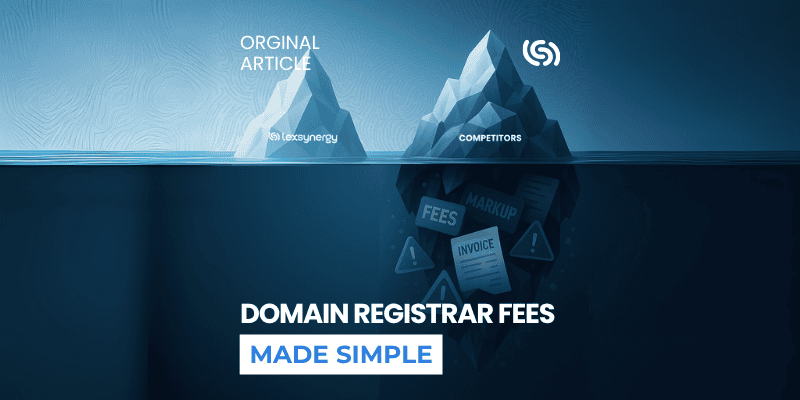
When it comes to managing global domain portfolios, many businesses are unknowingly overspending.