
Understanding the Domain Lifecycle
Domains do not last forever. From registration to renewal, decipher the jargon and get a grasp on this pivotal process.
25 Jun 2025
Read on


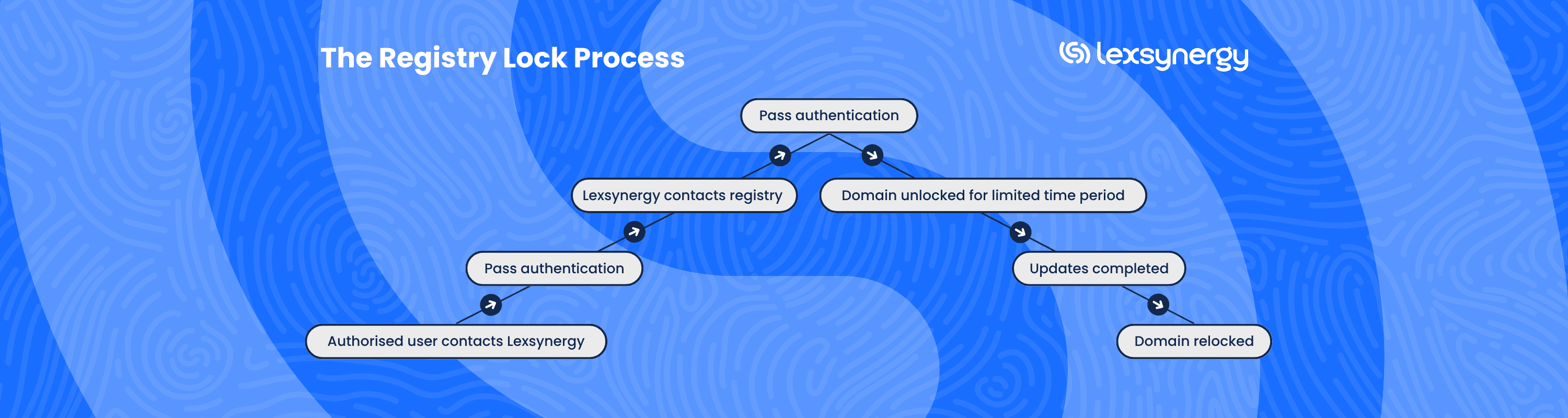
A Registry Lock is an advanced security feature that protects domain names from unauthorised changes by adding an out-of-band authentication step directly with the Registry Operator (the organisation that maintains the master database for the TLDs they operate, such as .com or .uk).

This means that before any critical domain action, (such as a domain transfer, deletion request or update of Nameservers) can take place, manual, human verification is required from both the registrar and the registry. The registry will not process changes unless they are explicitly approved through a pre-authorised communication channel (typically by phone or email with identity verification).
This added layer is crucial in preventing:
- Domain hijacking
- DNS redirection via phishing or social engineering
- Unauthorised changes due to compromised registrar credentials
In short: even if your registrar account and email are compromised, a Registry Lock keeps your domain(s) secure.
At Lexsynergy we define mission-critical (or Tier 1) domains as any namespace whose failure would materially impact revenue, reputation, legal compliance or public safety. Typical examples include:
- Primary website & login properties – example.com, login.example.com
- Transaction & payment endpoints – e-commerce, banking portals, API gateways
- Email-dependent TLDs – MX hosts, SPF/DMARC catch-alls
- Brand-defining ccTLDs or gTLDs – your country market homepages, flagship product sites
- Regulated extensions – .bank, .insurance, etc, where breach consequences include fines and customer remediation
If any of the above were to trigger a boardroom call or front-page headline, that domain is mission-critical and deserves a Registry Lock.
Most global registry operators support lock services, a few high-profile examples include:
TLD(s) |
.au (Australia) |
Many other ccTLDs from .ca (Canada) to .be (Belgium) offer similar programmes. Engage with us to see if your mission-critical domains are covered.
While coverage is growing, some legacy or smaller registries have not launched a lock service yet. In those cases, Lexsynergy can implement a Registrar Lock with our own manual authorisation workflow. It means that changes made via the Lexsynergy portal will require an "out-of-band" authorisation process for the update to take effect.
Any request to update a domain, such as changing the registrant contact information or transferring ownership, must go through a special verification process to confirm the identity of the requestor. This prevents unauthorised changes and helps to protect the domain from being hijacked or stolen.
Without any lock - Attacker reroutes DNS in minutes, diverting traffic, emails and 2FA codes
With Registry Lock - Change request blocked pending human verification; attacker fails
Without any lock - Fraudulent transfer to another registrar completes
With Registry Lock - Registry denies transfer; security team alerted
It is clear that the cost of a Registry Lock is negligible compared with the potential incident-response, lost revenue or regulatory penalties from not having it in place.

If the thought of a domain hijack keeps you up at night, or if an auditor is already asking about a Registry Lock, engage with us today. We will conduct an audit of your entire domain portfolio, identify gaps, and activate Registry Locks where it matters most.
Do not wait for the next headline-grabbing breach. Protect your domains now with a Registry Lock, because your brand, your customers and your peace of mind are worth it.
Want to learn more about Domain Locking?
Request an in-depth brochure by filling out the form and one of our dedicated account managers will be in touch. They will be able to answer any questions you may have and provide further tailored insights into how Domain Locking fits within your domain and brand protection strategy.
Domains do not last forever. From registration to renewal, decipher the jargon and get a grasp on this pivotal process.

Understand how the Domain Escrow Process protects both buyers and sellers with our step by step break down.

Gain control of your domain portfolio with a secure, centralised solution.